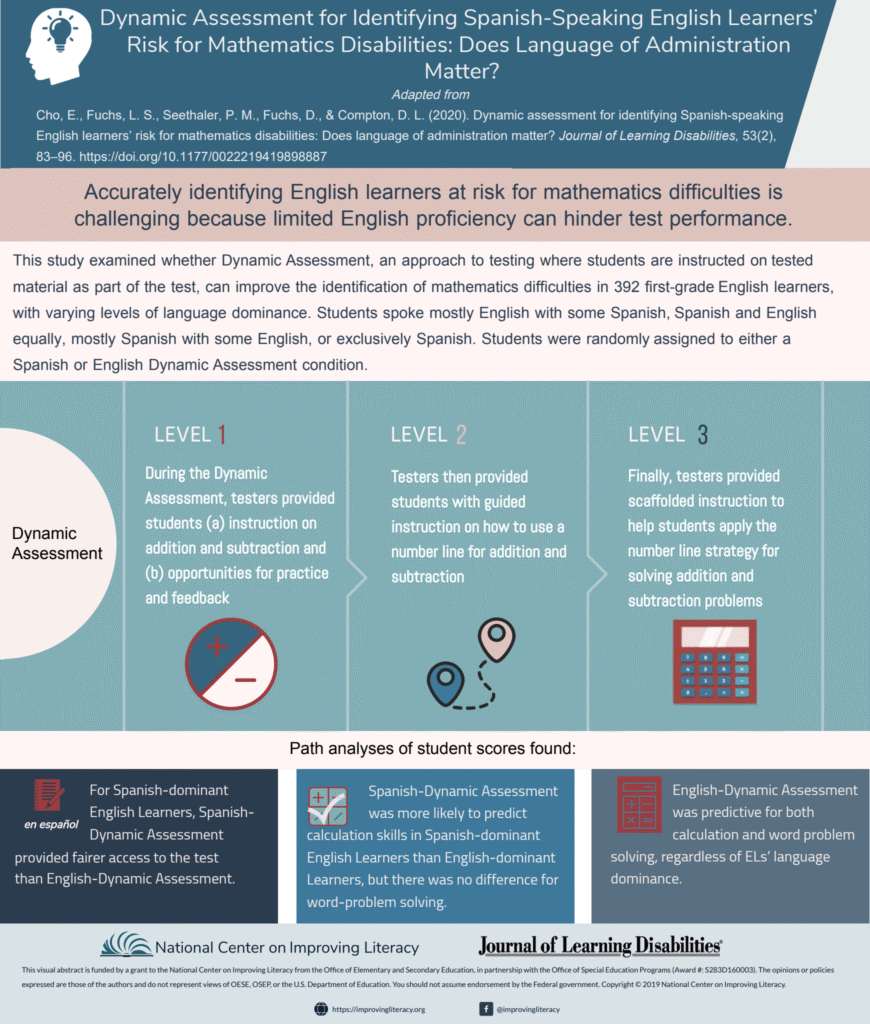

Accurately identifying mathematics disabilities in English learners requires assessments that distinguish between a student’s mathematical understanding and the language demands of the test itself. Traditional assessments may underestimate students’ abilities when limited English proficiency affects how they understand directions or express their knowledge. This study examined whether dynamic assessment (a testing approach that combines instruction, guided practice, and feedback during the assessment process) can improve the identification of first-grade Spanish-speaking English learners who may be at risk for mathematics disabilities.
The researchers studied 392 first-grade English learners representing a range of language backgrounds, from students who primarily spoke English to those who primarily or exclusively spoke Spanish. Students were randomly assigned to complete the dynamic assessment in either English or Spanish. Rather than simply measuring what students already knew, the assessment evaluated how well they learned new mathematical strategies when provided with structured instruction and support. During the assessment, students received increasingly guided instruction on addition, subtraction, and the use of number lines before applying those strategies to solve mathematical problems.
The findings highlight the importance of considering a student’s language background when selecting assessment tools. For students who were primarily Spanish-speaking, receiving the dynamic assessment in Spanish provided a fairer opportunity to demonstrate their mathematical abilities than receiving the same assessment in English. The Spanish version was also better at predicting later calculation performance for these students. At the same time, the English version of the assessment successfully predicted both calculation and word-problem performance across students with different levels of English proficiency.
Overall, this research demonstrates that dynamic assessment offers a promising approach for identifying mathematics risk among English learners because it measures students’ capacity to learn rather than relying solely on their current performance. The results also reinforce the importance of thoughtful decisions about the language in which assessments are administered. Matching the assessment language to students’ language strengths, particularly for Spanish-dominant learners, can improve the fairness and accuracy of screening. By using assessment methods that better capture students’ mathematical potential, educators can make more informed decisions about which students need additional support and intervene earlier to improve long-term learning outcomes.