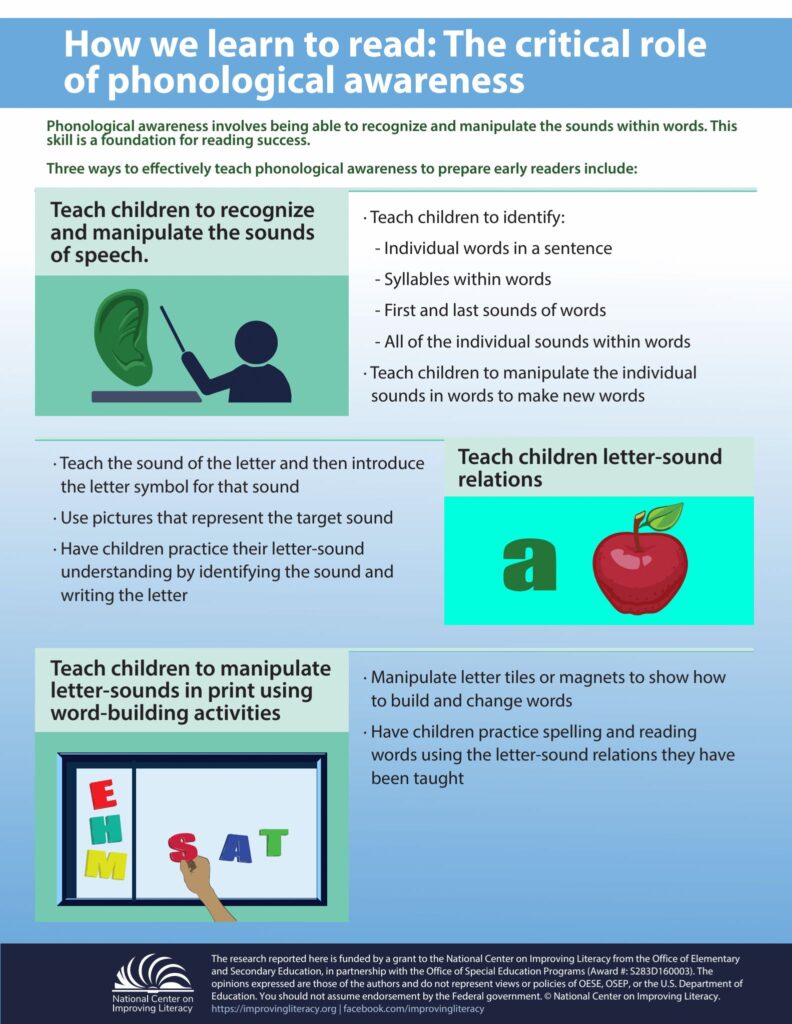

Phonological awareness is a purely auditory skill that forms the foundation for understanding the alphabetic principle and achieving long-term reading success. Although many children enter kindergarten with an intuitive understanding of how spoken sounds map onto letters, others face significant challenges. In particular, students with dyslexia frequently experience pronounced difficulties in hearing and isolating these individual speech sounds. For these learners, receiving high-quality, research-supported instruction and targeted interventions is critical to closing foundational reading gaps.
To prepare early readers effectively, educators should implement a structured instructional sequence that progresses systematically from basic phonological tasks to complex print connections. First, teachers must guide children to recognize and manipulate the sounds of speech. This process should move from easier activities to more difficult ones, starting with identifying whole words in sentences and syllables within words. Instruction then advances to distinguishing the first and last sounds of words (onset and rime) before culminating in the isolation and manipulation of individual sounds, known as phonemes, to form completely new words.
Second, instruction must explicitly transition students from auditory awareness to letter-sound relations. Teachers should introduce high-frequency consonants and short vowels in standard word contexts, ensuring letters represent their most common sounds, such as the short “a” sound in “bat” rather than “was”. A strong lesson structure involves naming the letter, presenting its symbol, and using a picture as an anchor or memory aid. Students then reinforce this knowledge by identifying the target sound and practicing writing the letter across various settings, backed by routine reviews to ensure long-term retention and automaticity.
Finally, educators should integrate word-building activities that allow students to manipulate letter-sounds directly in print. By utilizing physical materials like letter tiles or magnets, students physically connect their phonological skills with orthographic patterns. Moving from guided teacher practice to collaborative partner work, students learn to actively add, omit, or substitute letters to decode and spell increasingly complex structures, such as words featuring a silent e. Ultimately, NCIL infographics serve as versatile tools that can be embedded into professional learning communities, family literacy nights, and schoolwide initiatives to build widespread alignment around the science of reading.