
Universal literacy screening is an important part of early reading instruction because it provides educators with timely information about students’ literacy development before significant reading difficulties become established. Rather than serving as a comprehensive diagnostic evaluation, screening is designed to quickly identify which students may benefit from additional assessment, targeted instruction, or intervention. When implemented effectively, universal screening allows schools to make informed instructional decisions early, increasing the likelihood that students receive support before reading challenges become more difficult to address.
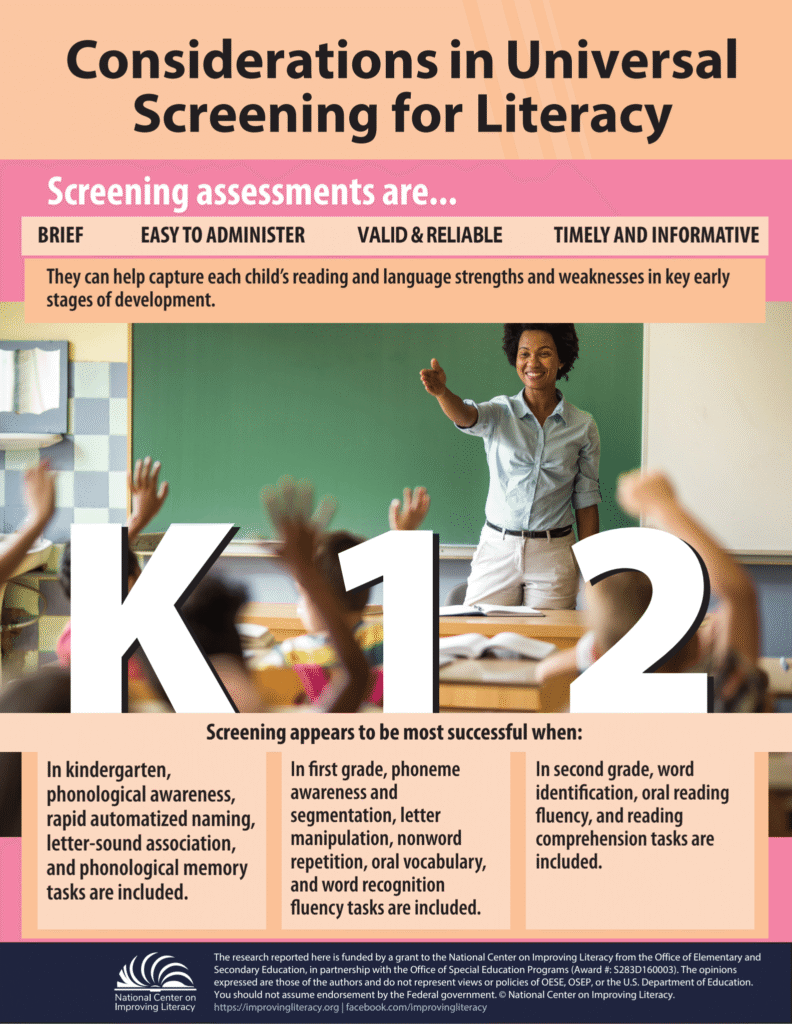
An effective screening assessment is built around several essential qualities. It should be brief enough to administer efficiently to all students while still providing meaningful information. It should also be easy for educators to administer consistently across classrooms and schools. Most importantly, screening tools should be valid and reliable, meaning they accurately measure the skills they are intended to assess and produce dependable results over time. These characteristics help ensure that screening data can be used confidently when making instructional decisions.
The skills included in literacy screening evolve as students progress through the early elementary grades because reading development changes rapidly during this period. In kindergarten, screening focuses primarily on foundational language and phonological skills that prepare children to learn to read. By first grade, assessments expand to include early decoding, vocabulary, and word recognition skills as students begin applying their knowledge to printed words. By second grade, screening increasingly emphasizes fluent reading and reading comprehension, reflecting the growing expectation that students use their foundational skills to understand connected text. Matching screening measures to students’ developmental stages provides educators with more accurate information about where students are succeeding and where additional instruction may be needed.
Universal screening is most effective when it is viewed as one component of a comprehensive system of literacy instruction. Screening data can help educators identify patterns of student performance, monitor the effectiveness of core instruction, and determine which students may require more intensive support. When combined with ongoing classroom observation and additional assessments as needed, screening results help create a clearer picture of each student’s reading development. By using reliable screening practices early and consistently, schools can make timely instructional decisions that support stronger reading outcomes and help more students build a successful foundation for future learning.