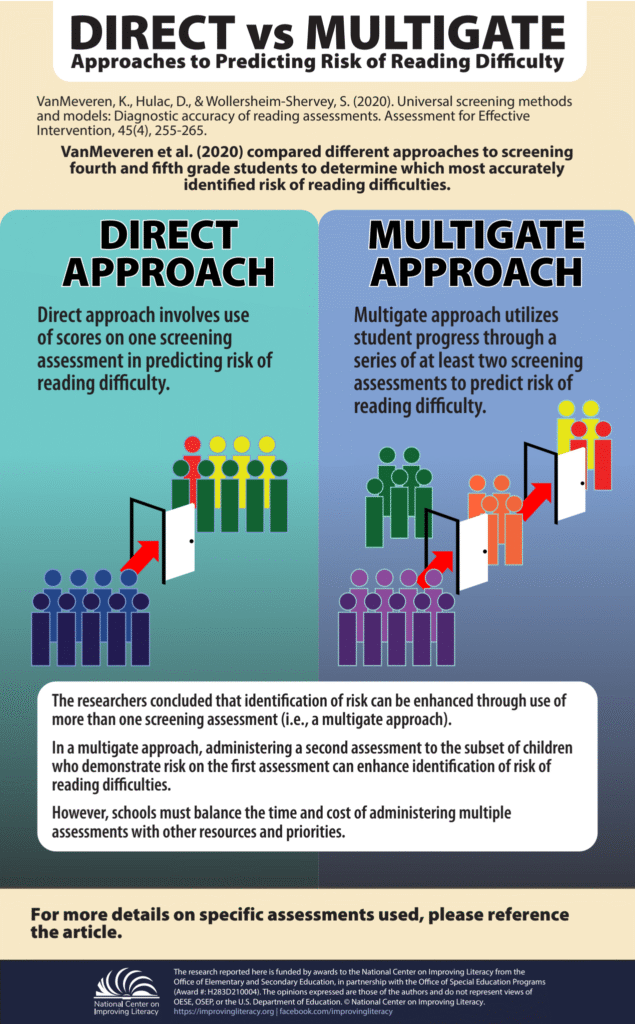

Universal reading screening is an essential part of helping schools identify students who may need additional reading support before they fall further behind. However, simply administering a screening assessment is not enough. Educators also need confidence that the screening process accurately distinguishes students who are likely to experience reading difficulties from those who are not. The study by VanMeveren and colleagues explores this challenge by comparing two different approaches to screening upper elementary students and examining which method more accurately predicts reading risk.
The researchers evaluated a direct screening approach, which relies on the results of a single assessment, and a multigate approach, which uses a sequence of assessments to refine decisions about which students are truly at risk. Rather than administering every assessment to every student, the multigate model begins with an initial screening and then follows up only with students whose first results suggest potential risk. This stepwise process is designed to improve decision-making while limiting the number of additional assessments that schools must administer.
The findings suggest that using more than one screening measure can improve the accuracy of identifying students who need intervention. A second assessment provides additional information that helps distinguish students who are genuinely at risk from those whose initial screening results may have overestimated their needs. More accurate identification allows schools to better target instructional support, reducing the likelihood that students who need help are overlooked while also avoiding unnecessary interventions for students who are already on track.
At the same time, the research highlights an important practical consideration. Although a multigate approach can improve diagnostic accuracy, it also requires additional time, staffing, and resources. Schools must weigh these benefits against the costs of administering multiple assessments, particularly when working within limited schedules and budgets. The most effective screening system is one that balances accuracy with feasibility so that students receive timely support without placing unnecessary demands on educators.
Overall, this research demonstrates that universal screening is not simply about choosing a high-quality assessment. It is also about designing an effective screening process. By carefully considering how assessments are combined, schools can make more informed decisions about student risk and allocate intervention resources where they are likely to have the greatest impact.