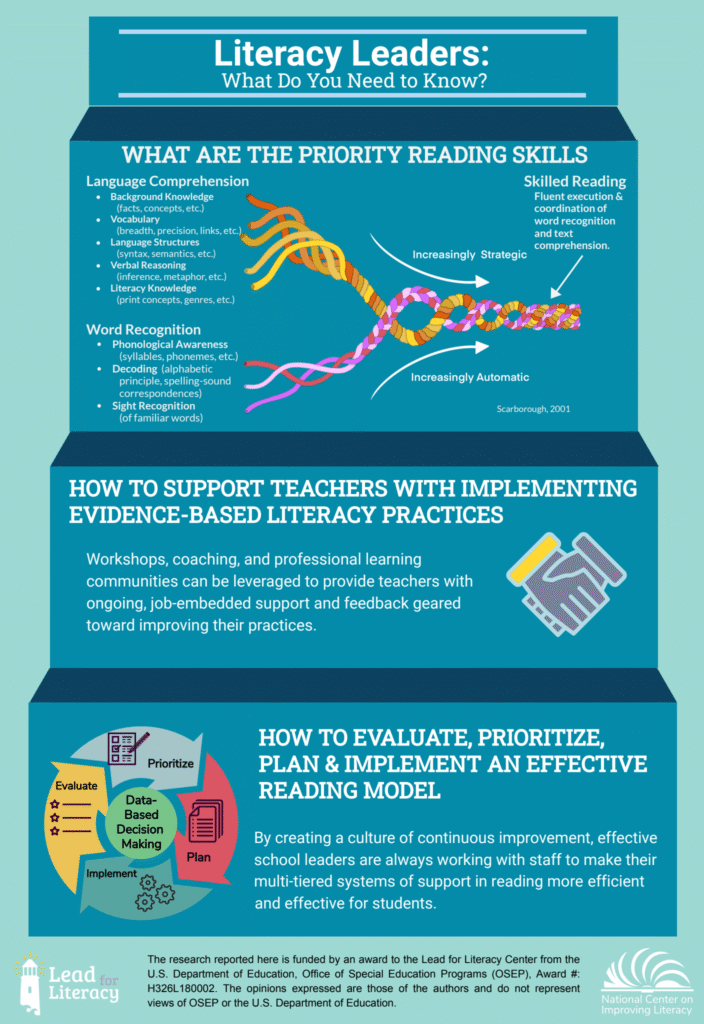

This resource highlights critical considerations for school administrators aiming to establish highly effective reading models within their buildings. Grounded in established literacy frameworks, the resource emphasizes that skilled reading is achieved through the fluent execution and coordination of word recognition and text comprehension. To guide instructional priorities, school leaders must ensure that classroom practices comprehensively target both of these core components:
- Language Comprehension: Cultivating proficient text comprehension requires systematic focus on building background and vocabulary knowledge, expanding literacy knowledge, mastering language structures, and strengthening verbal reasoning skills. These elements together allow students to derive deep meaning from text.
- Word Recognition: Building accurate and automatic word reading depends on explicit instruction in foundational skills, including phonological awareness, decoding and spelling strategies, and automatic sight recognition of familiar words.
Knowing the science of reading is only the first step; literacy leaders must actively support educators in translating this research into daily practice. Because standard professional development often fails to alter classroom habits permanently, leaders should leverage structured, ongoing, and job-embedded support mechanisms. Implementing high-quality workshops, instructional coaching, and professional learning communities (PLCs) ensures that teachers receive the real-time feedback and collaboration necessary to continuously refine their instructional delivery.
Furthermore, maximizing student outcomes requires leaders to strategically evaluate, prioritize, plan, and implement a cohesive reading model. Effective school administrators establish a culture of continuous improvement, regularly reviewing student data alongside staff to optimize their Multi-Tiered Systems of Support (MTSS) in reading. By refining core classroom instruction and aligning targeted intervention systems, leaders ensure that literacy instruction becomes increasingly efficient, equitable, and effective for every student across the entire school community.