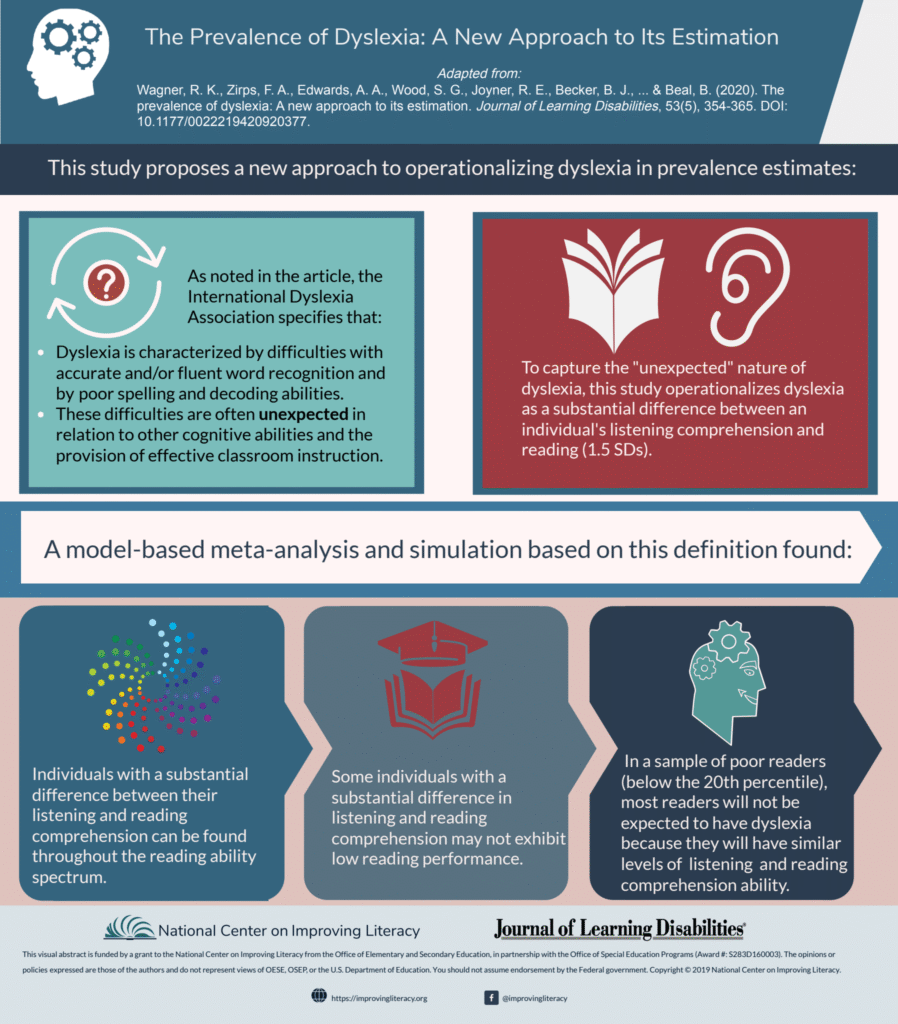

Determining how many people have dyslexia has long been a challenge because there is no single, universally accepted way to define or identify it. Different studies have used different criteria, leading to a wide range of prevalence estimates. In The Prevalence of Dyslexia: A New Approach to Its Estimation, Wagner and colleagues propose a new method that more closely reflects the widely accepted definition of dyslexia. Rather than identifying dyslexia based only on low reading scores, the researchers emphasize that dyslexia is characterized by reading difficulties that are unexpected when compared with an individual’s other language abilities and opportunities to learn.
To capture this idea of “unexpectedness,” the researchers compared listening comprehension and reading comprehension. Listening comprehension reflects a person’s ability to understand spoken language, while reading comprehension depends on both language understanding and the ability to recognize written words. When there is a substantial gap between these two skills, it may indicate that a person’s reading difficulties are specific to decoding and word recognition rather than a broader challenge with language comprehension. Using a model-based meta-analysis and statistical simulations, the researchers explored how often this type of discrepancy occurs across the population.
One of the study’s most important findings is that dyslexia cannot be identified simply by looking at low reading performance. Some individuals who demonstrate the characteristic gap between listening and reading comprehension may still achieve reading scores that fall within the average range. At the same time, many students who score poorly on reading assessments may not meet this definition of dyslexia because their listening and reading comprehension are similarly low. In other words, poor reading and dyslexia are related, but they are not synonymous. This distinction helps explain why relying on a single reading score can either miss some individuals with dyslexia or incorrectly classify others. The research encourages educators, researchers, and policymakers to think more carefully about how dyslexia is identified and how prevalence estimates are calculated. By considering the relationship between reading and listening comprehension, this approach provides a more precise way to understand the nature of dyslexia and highlights the importance of comprehensive assessment. Ultimately, the study reinforces that identifying dyslexia requires looking beyond overall reading achievement to better understand the underlying pattern of strengths and challenges each learner demonstrates.