
Helping a child learn to read is one of the most important goals in school. When reading skills are strong, students can learn across all subjects and build confidence as readers. But, when reading is difficult, it can affect many parts of a child’s school experience. If students aren’t given the instruction they need to learn to read early on, challenges in school can grow. This is why schools are concerned about the best ways to identify and support students with reading difficulties, including dyslexia, from the earliest signs there may be a reading problem.
For many years, schools relied mostly on test scores to decide if a child needed specialized instruction to learn to read. While test scores are important, they do not tell the whole story. In recent years, many schools began using an approach called “response to intervention” or RTI, which calls for providing evidence-based reading instruction to all students, progress monitoring, and data-driven decision making. The idea is that these tools help schools better understand not just what a student knows, but how they respond to effective instruction over time. There can be problems with this approach, too – for example, if schools aren’t delivering effective instruction aligned with reading research, if they fail to use data to adapt instruction, or if they wait too long to provide students with needed intervention support. In all cases, intervention efforts should not delay or deny referral for a comprehensive evaluation when a disability is suspected.
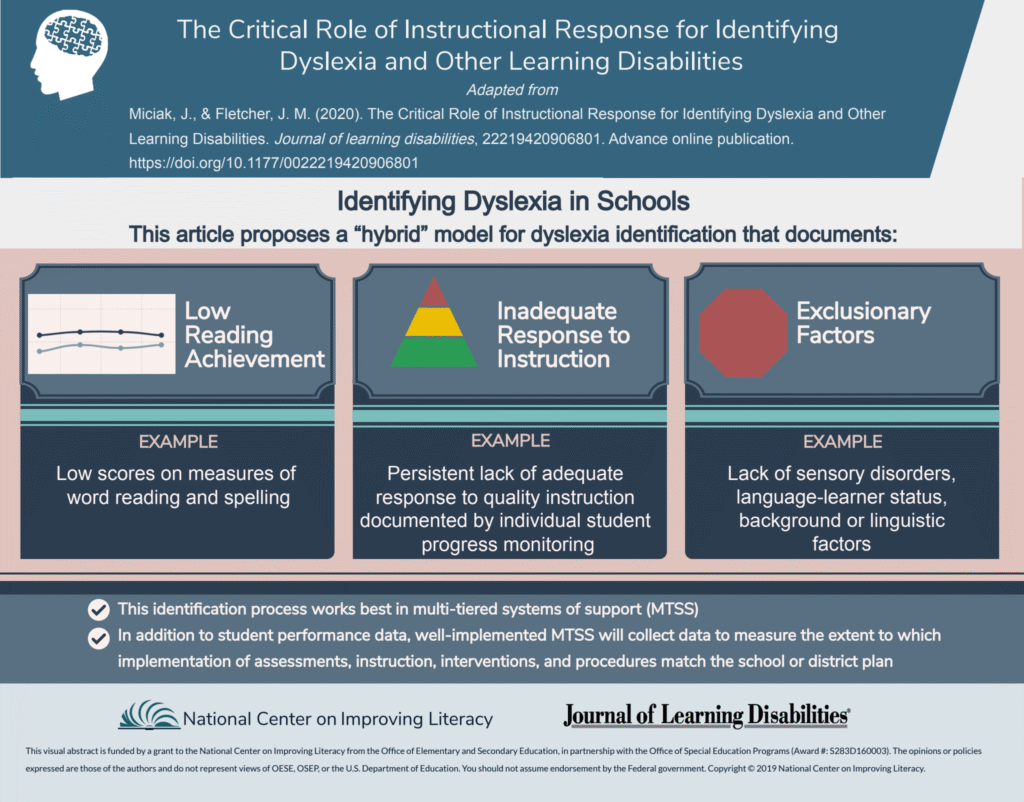
Miciak and Fletcher (2020) proposed a hybrid model for identifying dyslexia and other reading-related learning disorders that looks at three things together: low reading achievement, like difficulty reading and spelling that are common signs of dyslexia; inadequate response to effective reading instruction; and exclusionary factors such as sensory disorders or language background. The hybrid model works best within systems like MTSS (Multi-Tiered System of Supports). These systems are designed to provide different levels of support based on student need at the earliest sign of reading difficulty. All students receive strong classroom instruction, while some receive additional small-group intervention support to target their reading needs. Throughout this process, teachers collect data to see what is working and what needs to change. In the hybrid model, if the support provided in general education isn’t working – if students don’t respond to the instruction as expected – and their reading skills are lower than those of other children their age or grade, the student may need specialized reading instruction through an individual education plan (IEP),
It is also important to make sure that reading difficulties are not caused by other factors, such as other sensory disorders or language background – to make sure students get the right kind of support at school. By looking at the full picture, schools can make fair and informed decisions about how to support each child. Families play a key role as well. When schools share clear information about reading instruction, learning progress, and interventions provided, families can better understand their child’s needs and support learning at home. This partnership helps create a consistent and supportive environment for the child.
In today’s schools, identifying reading difficulties is not just about labeling a problem. It is about understanding how a student learns and responding with the right support. By using strong systems of support that include effective reading instruction and intervention, focusing on how students respond to instruction, and evaluating their level of reading skills compared to other students, schools can help every child build the skills they need for reading success.
For more information on Child Find, please see the following:
- What Is Child Find? (Understood.org)
- Return to School Roadmap — Child Find Under Part B of the Individuals with Disabilities Education Act (ED)