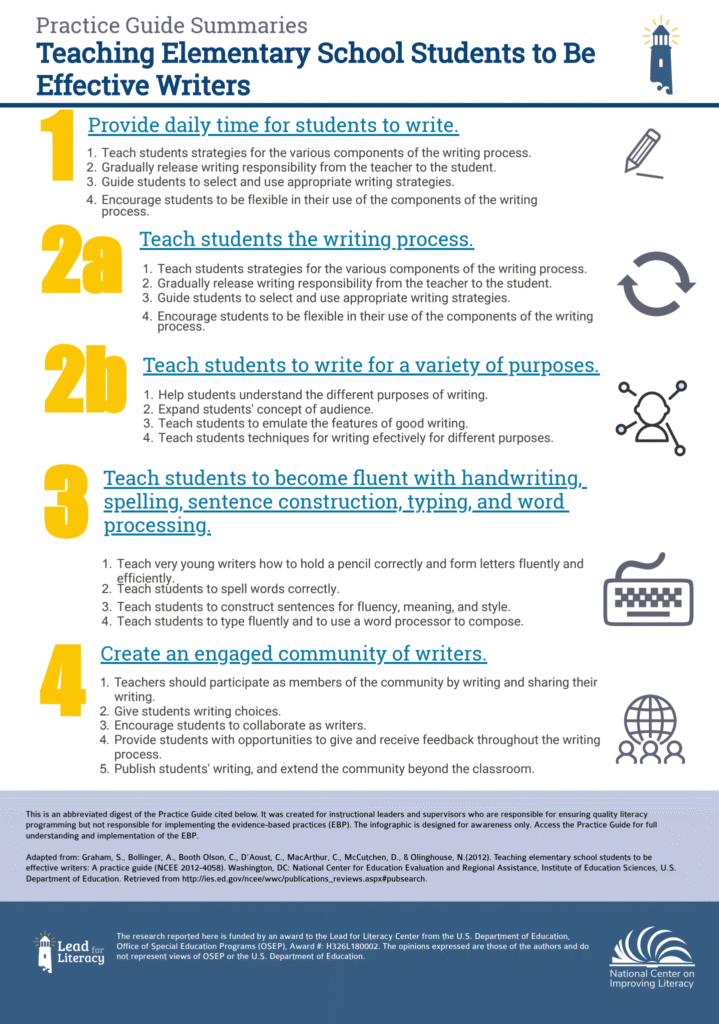

This resource outlines several evidence-based recommendations for improving writing instruction in elementary schools. One major recommendation is providing students with daily opportunities to write. Regular writing practice helps students develop confidence, fluency, and familiarity with the writing process over time.
The guide emphasizes explicitly teaching the writing process, including planning, drafting, revising, editing, and sharing writing. Teachers are encouraged to model these processes and gradually shift responsibility to students as they become more independent writers. Students should also learn how to select and apply different writing strategies flexibly depending on the task and purpose.
Another key recommendation is teaching students to write for different purposes and audiences. Students benefit from understanding that writing changes depending on whether they are informing, persuading, explaining, or telling a story. The resource encourages teachers to expose students to strong examples of writing and explicitly teach the features that make writing effective for different situations.
The guide also highlights the importance of foundational writing skills, including handwriting, spelling, sentence construction, typing, and word processing. Students need fluent transcription skills so they can focus more attention on expressing ideas and organizing their thoughts in writing.
Finally, the resource encourages schools to create an engaged community of writers. Teachers are encouraged to model writing themselves, provide students with meaningful writing choices, and create opportunities for collaboration and feedback. Sharing and publishing student writing can help build motivation and reinforce the idea that writing is a meaningful form of communication. Overall, the guide emphasizes that effective writing instruction combines explicit teaching, consistent practice, and supportive classroom environments.