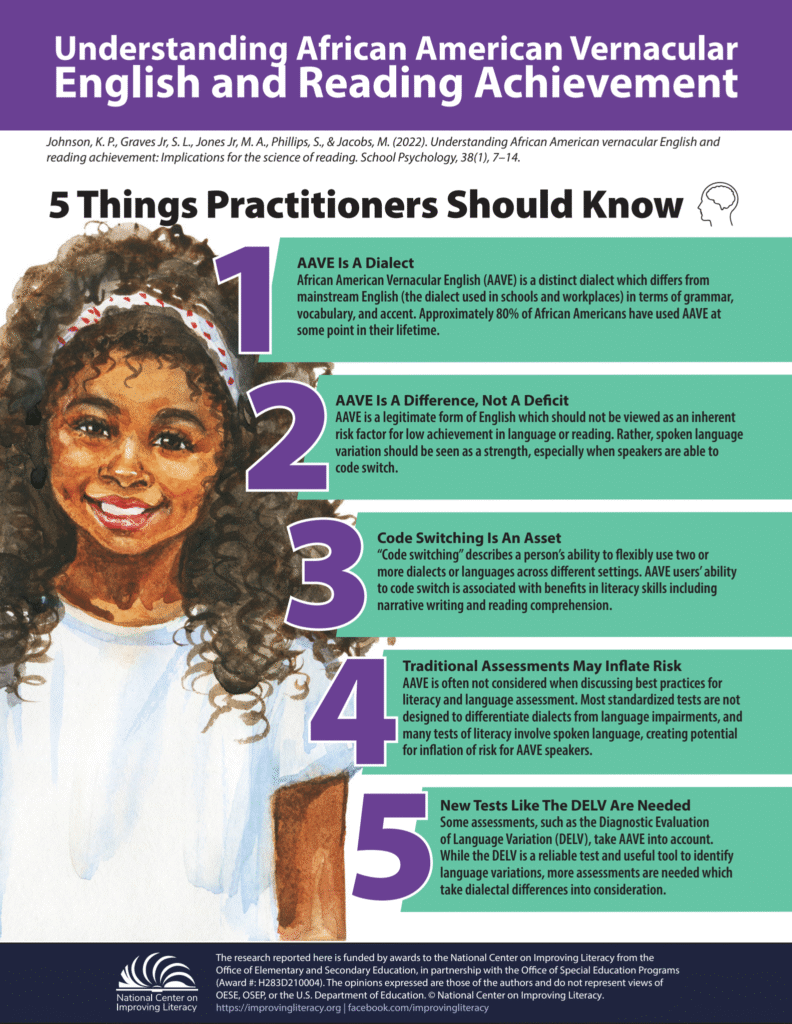

The science of reading has strengthened educators’ understanding of how children learn to read, but effective literacy instruction also requires an understanding of the language backgrounds that students bring to the classroom. The research summarized in this resource explores the relationship between African American Vernacular English (AAVE) and reading achievement, emphasizing that dialectal differences should not be mistaken for language deficits. Instead, the authors argue that recognizing and respecting students’ home dialects is an important part of providing accurate assessment and meaningful instruction, along with distributing educational opportunities.
AAVE is a legitimate, systematic variety of English with its own grammar, vocabulary, and pronunciation patterns. Like other dialects, it follows consistent linguistic rules rather than representing incorrect or incomplete English. Understanding this distinction is important because misconceptions about AAVE can influence how educators interpret students’ language and literacy skills. When dialectal differences are viewed as errors instead of expected language variation, students may be perceived as having reading or language difficulties that are not actually present. The research encourages educators to view linguistic diversity as an asset rather than a barrier to learning.
The article also highlights the value of code-switching, or the ability to move between different dialects depending on the situation. Students who can successfully navigate both AAVE and mainstream classroom English demonstrate linguistic flexibility that can support communication, academic success, and literacy development. Rather than encouraging students to abandon their home dialect, the research suggests helping them build proficiency in multiple language varieties so they can communicate effectively across a range of settings. This approach respects students’ identities while expanding their academic language skills.
Another important focus of the research is literacy assessment. Many commonly used language and reading assessments were not designed to account for dialectal variation, creating the possibility that AAVE speakers may be identified as at risk when they are simply demonstrating expected features of their dialect. The authors discuss the need for assessment tools that distinguish language differences from language disorders and highlight newer measures that have been developed with dialectal variation in mind. They also encourage continued research to improve assessment practices so that students receive appropriate support based on their actual learning needs rather than misunderstandings about the way they speak. Overall, this research reinforces that culturally and linguistically responsive instruction is an essential component of high-quality reading education. By recognizing AAVE as a legitimate dialect and considering language variation throughout instruction and assessment, educators can make more accurate decisions while creating learning environments that value students’ linguistic strengths and promote literacy success for all learners.