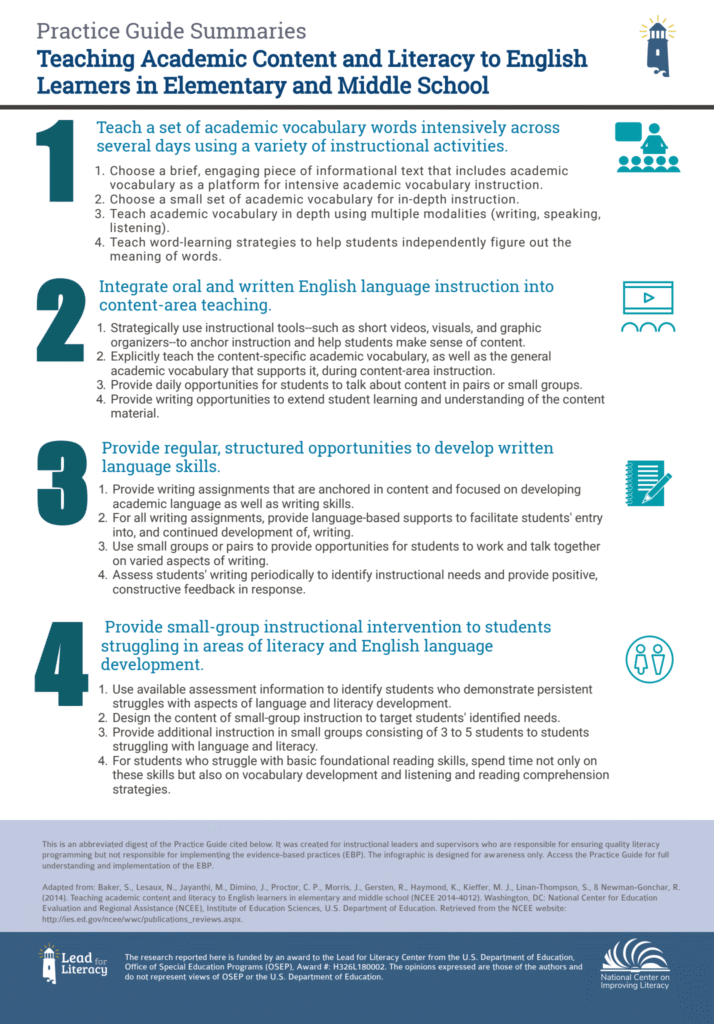

This resource outlines several evidence-based recommendations for supporting English learners in elementary and middle school settings. A major focus of the guide is explicit vocabulary instruction. Educators are encouraged to teach a small set of academic vocabulary words in depth over several days using speaking, listening, reading, and writing activities. The guide also recommends teaching students strategies for independently determining the meaning of unfamiliar words.
The resource emphasizes the importance of integrating language instruction into content-area teaching rather than teaching language skills in isolation. Teachers are encouraged to use visuals, videos, graphic organizers, and structured discussion opportunities to help students better understand academic content. Students should have frequent opportunities to discuss ideas with peers and respond to content through writing activities.
Another key recommendation is providing structured support for writing development. Writing tasks should connect to classroom content and include language supports that help students organize and communicate their ideas. Collaborative writing activities in pairs or small groups can also support language growth and engagement.
Finally, the guide highlights the importance of small-group intervention for students experiencing difficulties with literacy or English language development. Assessment data should be used to identify specific student needs and guide instruction. Small-group support should target foundational reading skills while also building vocabulary, comprehension, and oral language abilities. Overall, the resource reinforces the importance of intentional, language-rich instruction that supports both literacy and academic success for English learners.