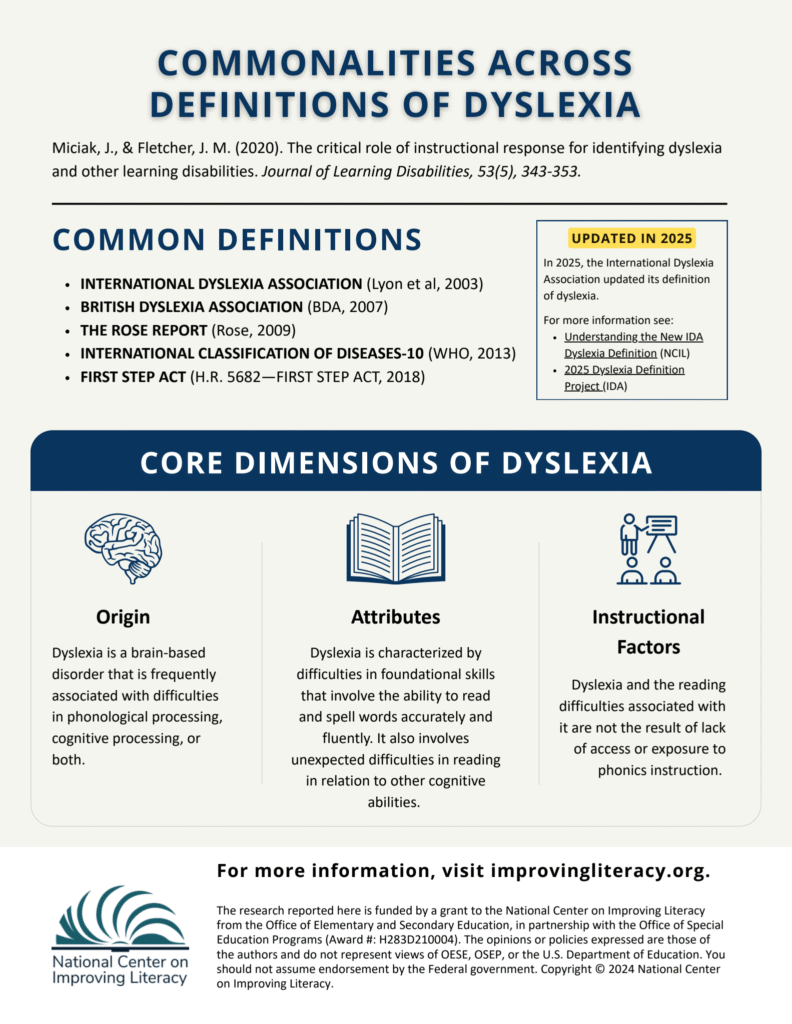
Although researchers and organizations have proposed a variety of definitions for dyslexia, many of them identify the same core characteristics. Across major definitions, dyslexia is consistently understood as a neurobiological condition that primarily affects the development of reading and spelling skills. Difficulties often stem from weaknesses in phonological processing (the ability to recognize and manipulate the sounds in spoken language), which can make learning to read, spell, and decode words significantly more challenging. These challenges are not a reflection of intelligence, motivation, or effort, but rather differences in how the brain processes written language.
Another point of agreement is that dyslexia is characterized by persistent difficulties with foundational reading skills. Individuals with dyslexia often struggle to read words accurately and fluently and may have difficulty spelling even after receiving instruction. These reading challenges can appear unexpected when contrasted with otherwise typical cognitive abilities and opportunities to learn. While the specific experiences of individuals with dyslexia vary, difficulties with accurate and fluent word reading remain one of its defining features.
An equally important aspect of identifying dyslexia is understanding the role of instruction. Reading difficulties should not be attributed simply to a lack of access to effective teaching or insufficient exposure to phonics. Instead, educators should consider how students respond to high-quality, evidence-based reading instruction. When a student continues to experience significant reading difficulties despite receiving appropriate instruction, that instructional response provides valuable information for distinguishing dyslexia from reading challenges that are primarily the result of limited instructional opportunities. This perspective supports more accurate identification and helps ensure that students receive interventions matched to their learning needs.
Taken together, these shared principles provide a consistent framework for understanding dyslexia. They emphasize that dyslexia has a neurological component, is marked by persistent difficulties with foundational reading and spelling skills, and should be considered within the context of a student’s opportunity to learn through effective instruction. Recognizing these common elements promotes clearer communication among educators, families, and specialists while supporting timely identification and intervention. When these principles guide decision-making, students are more likely to receive the targeted instruction and support needed to improve reading outcomes.